
FIELD STORY · GILGIT-BALTISTAN
How Shilajit Is Harvested at 17,000 Feet
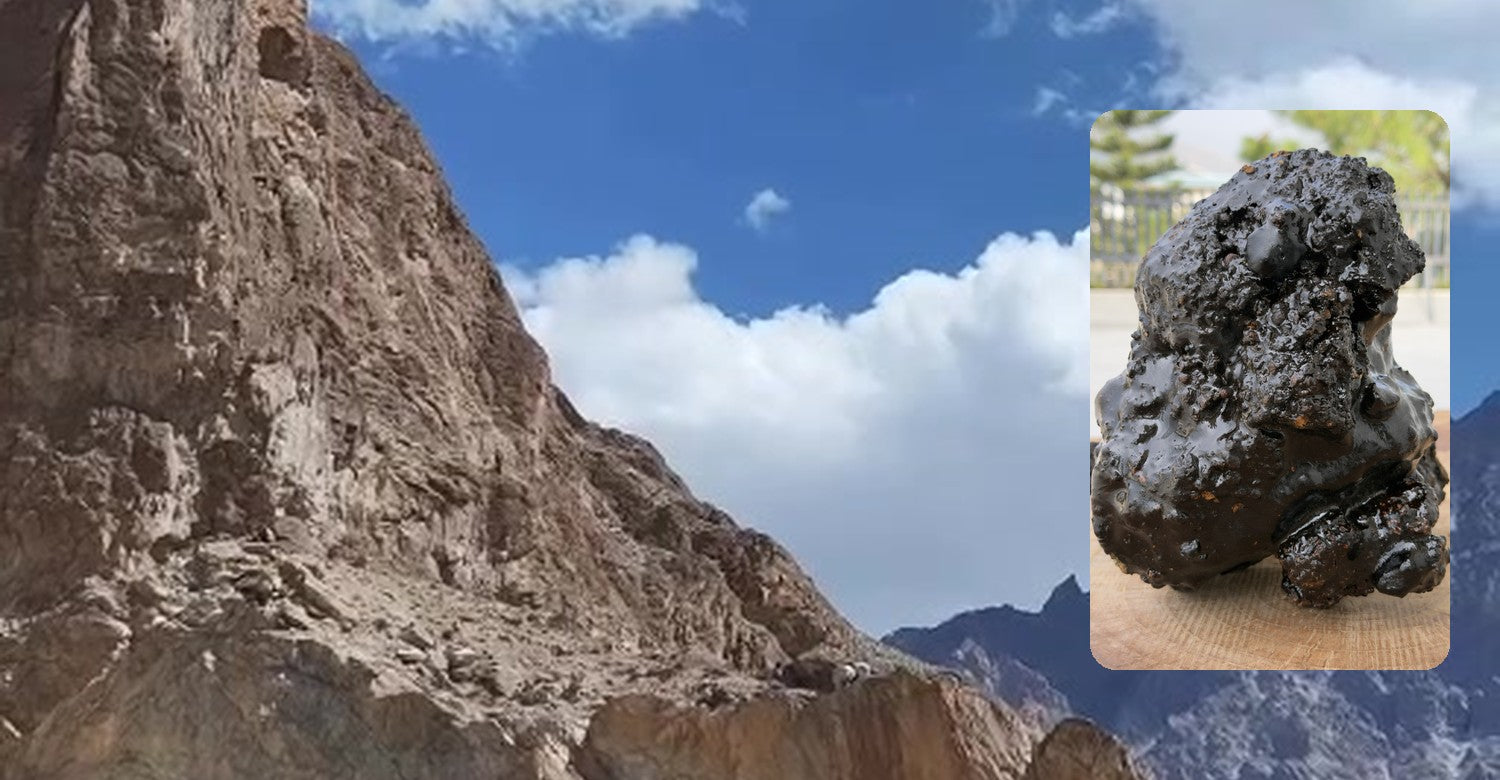
A photo story about high-altitude collection, community permission and careful handling in Pakistan’s mountain regions.
Approx. 5,180 metres · Educational field account · 28 October 2026
This article is based on the supplied field account and photographs/video. It separates those firsthand descriptions from scientific and regional context cited below.
FIELD STORY / GILGIT-BALTISTAN
At roughly 17,000 feet (about 5,180 metres), a shilajit collection trip is shaped by altitude, steep ground and a short working season. In the high mountain areas of Gilgit-Baltistan described by our field team, collection is a small-scale, hands-on task: reach a rock exposure, inspect natural seams, remove accessible material by hand, then carry and protect it on the journey down.
This photo story explains the process from the field account and supplied footage. The location names below describe the team’s sourcing area; they do not mean that every site is at 17,000 feet, that all sites are inside one continuous zone, or that a place name alone proves permission to collect there.
AT A GLANCE
The team describes community permission and payment before collection, hand tools instead of blasting, pack animals such as donkeys and horses where vehicle access ends, and moisture-protective storage after collection. Each site still needs its own authorization, and responsible collection requires checking local rules and environmental limits.
What is shilajit?
Shilajit is a dark, sticky natural material that seeps from cracks and cavities in mountain rock. Scientific literature describes it as a complex, variable mixture of organic matter and mineral components. A major review notes that its full chemical composition and exact origin are not settled, and that samples can differ by region. Geological field research in Tibetan areas has documented seepage associated with joints, faults and cavities in rock; that research helps explain how such deposits can appear, but it does not establish the geology of every Gilgit-Baltistan source. [1, 2]
That distinction matters. “Shilajit” is a common name for material with varied origins and composition, not a guarantee that every black deposit is the same substance or has the same quality. Appearance alone cannot confirm identity, purity or safety.
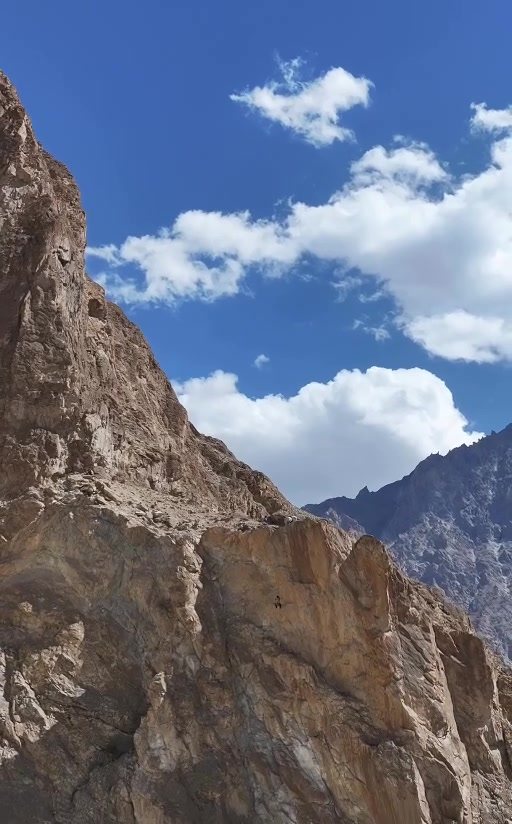 High mountain terrain in Gilgit-Baltistan · Still from supplied field footage/photo.
Where does the field account place collection?
The team describes sourcing in upper Gilgit-Baltistan, including mountain areas around Chilas, Hunza and Sost, the Pamir plateau, Shimshal, and areas it associates with Siachen. These are broad regional references from the team’s account, not an exact map of collection points. Elevation, route, access and the competent local authority can differ from one valley or slope to another.
Shimshal, for example, is identified by the Gilgit-Baltistan Forest, Wildlife and Environment Department as a community-managed conservation area and wildlife habitat. The Central Karakoram National Park also has core and buffer zones with different management objectives. So before collection, the right questions are practical: Who manages this specific land? What consent or permit is required? Does a protected-area or restricted-access rule apply? [3, 4]
A community agreement is meaningful, but should be recorded clearly: the permitted place and season, who gave consent, the amount or method of payment, how community funds are distributed, and who is responsible for monitoring the site. This article reports the team’s stated practice of paying the community, with funds distributed within the community; it does not independently audit each agreement.
How does hand collection work?
1. Reach the outcrop carefully
At high elevation, the approach can take more time than the collection itself. Collectors travel on foot over steep, loose or exposed ground. The supplied footage shows rock faces, cavities and hand inspection. According to the field account, donkeys and horses carry people’s provisions and collected material on routes where roads or vehicles cannot reach. Pack animals make remote access possible, but they still need suitable loads, rest and safe footing; routes should avoid fragile vegetation and unnecessary trail widening.
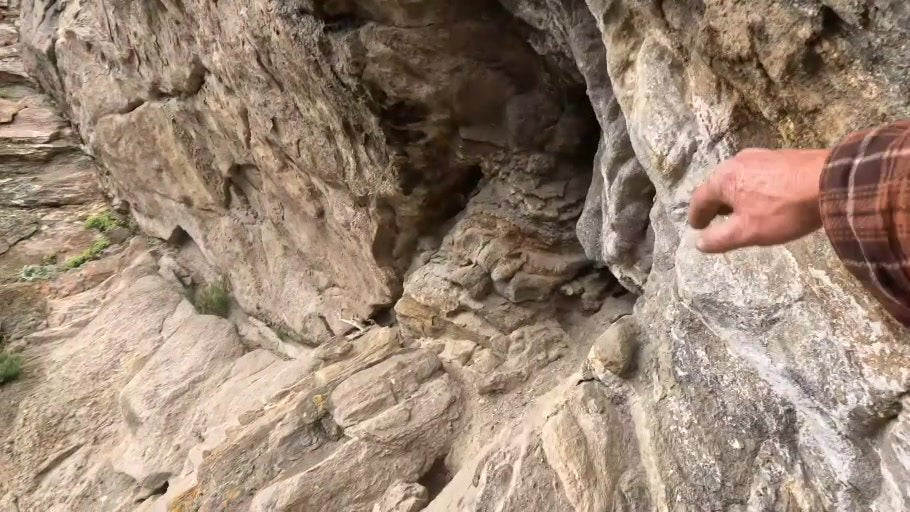 Rock cavity and hand inspection · Still from supplied field footage/photo.
2. Inspect the natural seam
Collectors look for dark material in a natural crack, sheltered cavity or weathered surface. The attached clips show close inspection of an outcrop and dark deposits on rock. A careful method works at the visible deposit rather than treating the mountain as a quarry. The team says it uses hand tools and does not use blasting. Avoiding explosives prevents blast damage and debris, but careful work also means not breaking surrounding rock, disturbing wildlife or leaving litter.
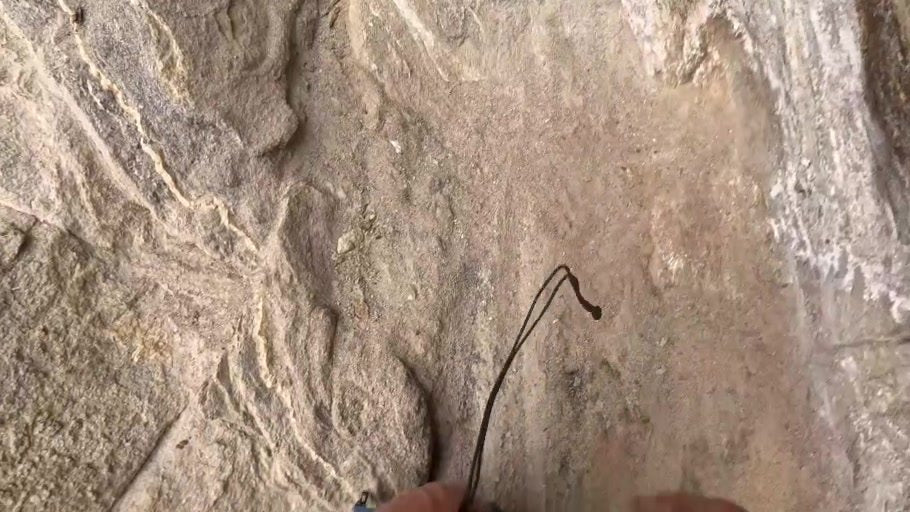 A visible dark seam on the rock · Still from supplied field footage/photo.
3. Remove only accessible material
The team describes hand removal with small tools. This is different from blasting or large-scale mechanical extraction. A responsible field protocol should define how much can be taken from a particular site, keep a record of each collection, and leave the rock face stable. No harvest quota, site-resting schedule or long-term ecological monitoring record was supplied for this article, so we do not claim that the practice has been scientifically shown to be sustainable.
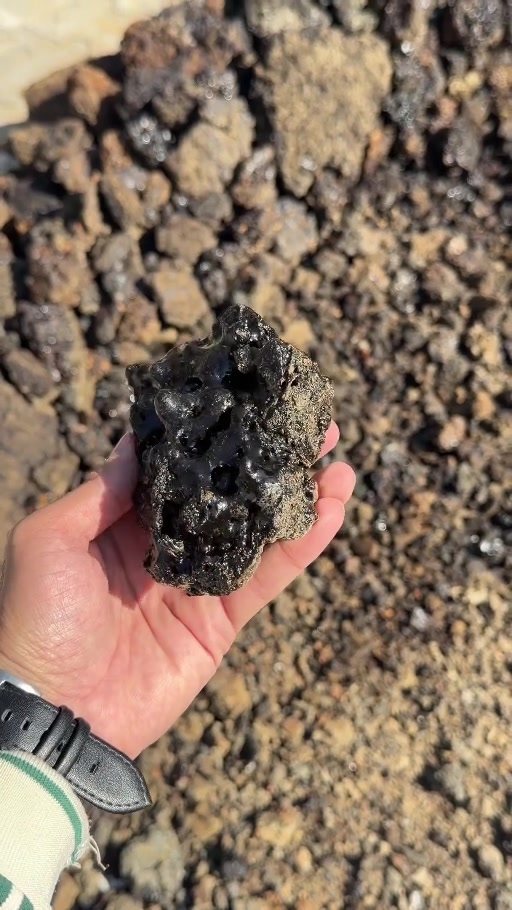 Raw shilajit in hand · Still from supplied field footage/photo.
4. Carry it down and keep it dry
The field account describes packing collected material in closed, moisture-resistant containers and protecting it from rain, meltwater and other contamination during transport. Pack animals may be used on remote sections of the route; people and vehicles may take over where the trail allows. At the first storage point, batches should remain sealed, labelled and separated so that material from different sites or collection dates is not casually mixed.
Good records connect the field parcel to its later handling: collection date, broad source area, collectors or team, permission reference, weight, container and transfer details. Those records support traceability; they do not replace laboratory testing.
What does ethical harvesting mean in practice?
Ethical collection joins three responsibilities: respect for people, care for the mountain, and truthful handling of the material. In the team’s account, community permission comes before extraction and payment is made to the community for distribution there. Permission should be renewed when the location, season or scale changes, and the community should be able to decline or set limits.
- Use hand tools and avoid blasting or heavy machinery at the collection face.
- Follow the landholder, community, conservation-area and access rules for that exact site.
- Agree on a site-specific amount and leave the surrounding rock and habitat intact.
- Carry out packaging, tool waste and other rubbish; keep routes narrow and camps clean.
- Use donkeys or horses only with appropriate loads, water, rest and safe handling.
- Record the collection and payments, and revisit the site to check for visible damage.
These are practical safeguards, not proof that every collection is low impact. High mountain ecosystems can be sensitive, and the effect of repeated extraction depends on the site and the quantity removed. Monitoring and transparent records are needed to make environmental claims responsibly.
Harvesting is only the first quality step
Raw shilajit is not automatically a finished or verified product. Research has found that samples can vary and may contain a range of elements. A study that tested two samples from Gilgit and Chellas detected several metals, including lead, while reporting concentrations within the limits it applied; a separate study of samples from India and Pakistan reported different findings. These results cannot be generalized to a particular batch. They show why batch-specific laboratory analysis matters. [1, 5, 6]
A credible quality process should document sample identity and test methods, and should report relevant contaminants such as lead, arsenic, cadmium and mercury against the standards applicable in the market where the product is sold. A lab report is only useful if it matches the same batch and is interpreted against a stated standard. Natural origin and careful harvesting do not by themselves establish safety.
This article is educational. It does not make health or treatment claims about shilajit, and the fact that a substance has a history of traditional use is not proof of a medical benefit.
Frequently asked questions
How high is 17,000 feet in metres?
About 5,180 metres. It is an approximate conversion. Collection elevations vary by site; 17,000 feet should not be read as the altitude of every named region or every trip.
Is shilajit mined with explosives?
The field account described here says collectors use hand tools and do not use blasting. That describes this team’s method, not every source or supplier.
Do donkeys and horses carry shilajit?
According to the team’s account, pack animals are used on remote routes where vehicles cannot reach. Load size, animal welfare and trail impact should be managed carefully.
Does community payment make a harvest ethical?
It is an important part of the account, but ethical practice also depends on valid site-specific permission, fair and transparent distribution, local rules, careful extraction and monitoring.
Can appearance prove shilajit is pure or safe?
No. Appearance cannot confirm identity, composition or contaminant levels. A batch-linked laboratory report is needed for meaningful quality checks.
Is shilajit collected at Siachen?
The field account names areas it associates with Siachen, but this article does not claim collection on the glacier or establish access rights. Exact location, security, conservation and land permissions must be verified with the relevant authorities before any activity.
The mountain-to-storage story
At around 17,000 feet, the story of shilajit begins with a difficult route and a natural deposit in stone. The field method described here depends on local knowledge, community consent, careful hand collection, pack transport where needed and dry, traceable storage. The most trustworthy account also says what remains to be checked: site-specific permits, environmental monitoring and independent batch testing.
Sources and further reading
[1] Kamgar E, et al. “A Comprehensive Review on Shilajit: What We Know about Its Chemical Composition.” Critical Reviews in Analytical Chemistry, 2025. PubMed record. Open source
[2] Wang et al. “Mechanisms of generation and exudation of Tibetan medicine Shilajit (Zhaxun).” Frontiers in Earth Science, 2020. Open source
[3] Gilgit-Baltistan Forest, Wildlife & Environment Department. Community Managed Conservation Areas (Shimshal profile). Open source
[4] Gilgit-Baltistan Forest, Wildlife & Environment Department. Central Karakoram National Park. Open source
[5] Rahim M, et al. “Heavy Metal Profile of Shilajit Samples Obtained from Gilgit and Chellas, Pakistan.” Journal of Physical Science, 2016;27(2):139. doi:10.21315/jps2016.27.2.10. Open source
[6] Aldakheel RK, et al. “Rapid Determination and Quantification of Nutritional and Poisonous Metals in ... Shilajit.” Biological Trace Element Research, 2022. PubMed record. Open source
Editorial note: Elevation is approximate; 17,000 feet is not a claim about every site named. This article does not verify specific permits, audit community payments, or certify ecological sustainability. Scientific sources support general context only; collection practices are attributed to the field account.